
suppressMessages(library(tidyverse))
suppressMessages(library(treeio))
suppressMessages(library(ggtree))
# library(ggimage)

nwk <- system.file("extdata", "sample.nwk", package = "treeio")
tree <- treeio::read.tree(nwk)
tree$node.label <- c("root", paste("node", 2:treeio::Nnode(tree)))
p <- ggtree(tree)ggtree–通用函数
ggtree
本节是对前四节的补充,它们大多是一些通用的函数。
-
%<+%:类似于full_join(),但是直接在ggplot对象中添加新的数据 -
hexpand(),vexpand():延长树图的宽度和高度 -
get_taxa_name():获取ggplot图中taxa的顺序和名称 -
label_pad():设置label的间隔 -
identify():获取ggplot对象中的数据
加载一颗基本树
%<+%
%<+% 固定使用数据第一列与p$data中的label列进行匹配。
fortify(tree)
#> # A tbl_tree abstraction: 25 × 9
#> # which can be converted to treedata or phylo
#> # via as.treedata or as.phylo
#>   parent  node branch.length label isTip     x     y branch angle
#>    <int> <int>         <dbl> <chr> <lgl> <dbl> <dbl>  <dbl> <dbl>
#> 1     20     1             4 A     TRUE     48    12   46    332.
#> 2     20     2             4 B     TRUE     48    13   46    360
#> 3     19     3             5 C     TRUE     43    11   40.5  305.
#> 4     18     4             6 D     TRUE     36    10   33    277.
#> 5     17     5            21 E     TRUE     48     9   37.5  249.
#> 6     22     6             4 F     TRUE     48     7   46    194.
#> # ℹ 19 more rows
d <- data.frame(tip = LETTERS[1:13], value = 1:treeio::Ntip(tree))
(p %<+% d)$data
#> # A tbl_tree abstraction: 25 × 10
#> # which can be converted to treedata or phylo
#> # via as.treedata or as.phylo
#>   parent  node branch.length label isTip     x     y branch angle value
#>    <int> <int>         <dbl> <chr> <lgl> <dbl> <dbl>  <dbl> <dbl> <int>
#> 1     20     1             4 A     TRUE     48    12   46    332.     1
#> 2     20     2             4 B     TRUE     48    13   46    360      2
#> 3     19     3             5 C     TRUE     43    11   40.5  305.     3
#> 4     18     4             6 D     TRUE     36    10   33    277.     4
#> 5     17     5            21 E     TRUE     48     9   37.5  249.     5
#> 6     22     6             4 F     TRUE     48     7   46    194.     6
#> # ℹ 19 more rows
hexpand(), vexpand()
text的长度在ggplot中不被考虑,很多时候文本注释信息会在图中显示不全被截断。
当使用coord_cartesian(clip = "off")时,超出边界的文本不会被裁剪,但仍然可能仍然无法显示。需要将x,y轴延展。
tree2 <- tree
tree2$tip.label <- paste0('to make the label longer_', tree2$tip.label)
ggtree::ggtree(tree2) + geom_tiplab() + hexpand(.4)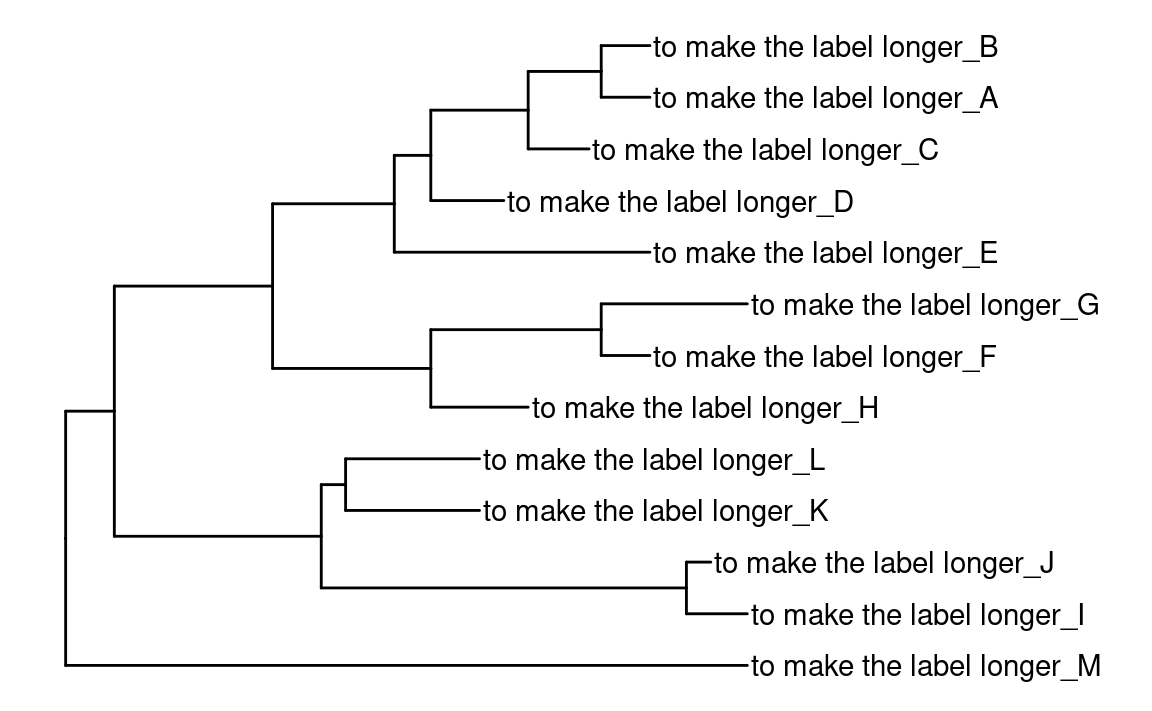
get_taxa_name()
获取taxa名称,顺序以树图中展示的为准。
get_taxa_name(p)
#>  [1] "B" "A" "C" "D" "E" "G" "F" "H" "L" "K" "J" "I" "M"
get_taxa_name(p, node = "node 12")
#> [1] "L" "K"
label_pad()
用来将label对齐,不足的部分使用某个字符填充。
chr <- c("a", "b", "cccccccc")
tibble::tibble(
  label = chr,
  label_pad = label_pad(label, pad = "."),
  label_pad_2 = label_pad(label, justify = "left", pad = ".")
)
#> # A tibble: 3 × 3
#>   label    label_pad label_pad_2
#>   <chr>    <chr>     <chr>
#> 1 a        .......a  a
#> 2 b        .......b  b
#> 3 cccccccc cccccccc  cccccccc
identify()
使用identify()函数,可以手动选择注释clade或tip(可能需要使用Rstudio)。